Mostrando entradas con la etiqueta Reading habits. Mostrar todas las entradas

sábado, 8 de abril de 2017

Reading test: Windsor Castle anti-terror barriers 'ugly', locals say


Read this BBC article and choose the world or phrase A-N that best fits into each gap. There are three words you do not need to use.  0 is an example.

Windsor Castle anti-terror barriers 'ugly', locals say 
New security barriers around Windsor Castle (0) … branded "ugly" by some locals. They were installed (1) …  to afford extra protection at Wednesday's Changing of the Guard ceremony (2) …  last week's attack in Westminster. Police asked the public to understand (3) … the barriers were "necessary".


But some residents in the Royal Borough have reacted (4) … to the extreme measure.  Many complained they were unattractive, (5) … others said the number of parking spaces had been reduced (6) … . Shami Kalra (7) … it was "sad" to see the "beautiful streets of Windsor" lined with anti-terrorism barriers, and gave the impression the town was "running scared". One woman living in the town commented the "ugly barriers" had been installed with "two hours notice" and tweeted: "If it's not safe to change the guard. Don't do it. The barriers severely impact people (8) … live there."

Thames Valley Police believe the measures are proportionate and necessary (9) … there is "no intelligence to indicate a specific threat to Windsor". The barriers will be in addition to the normal road closures which had (10) … been arranged for the Changing of the Guard event.

A - after
B - already
C - although
D - angrily
E - as a result
F - have been – 0 Example
G - however
H - overnight
I - said
J - told
K - while
L - who
M - why
N – yet


Photo: BBC


KEY:
1H 2A 3M 4D 5K 6E 7I 8L 9C 10B

miércoles, 9 de abril de 2014

Talking point: Reading

This week's talking point is reading. Before getting together with the members of your conversation group, go over the questions below, so that you can work out vocabulary problems beforehand and ideas flow more easily when you get together with your friends.

What kind of books do you read?
Do you read anything else i.e. newspapers, magazines?
How often and how much do you read?
Where do you like reading?
Do you read printed books and newspapers or do you prefer reading online?
What was the last thing you read?
Why do you read?
If you were going to recommend a book to a friend, what would it be and why would you recommend it?
Do you prefer reading a book or watching a film? Why?
Do you usually watch the film based on a book that you have read?
Do you have an e-book reader?
What are the advantages and disadvantages of e-book readers over books?
Will technology ever kill reading?

To illustrate the point you can watch this New York Times video where an American family tells us about their reading habits and the future of reading. 


I guess we are voracious readers because we can’t sit anywhere without reading something, sitting in a waiting room, on a train, we are nuts if we don´t have something to read.
I read about five newspapers a day, I read a number of weekly magazines, and I would say I always read some book before I go to sleep at night.
David Sims and his wife Jean clearly enjoy reading. Every room in their house in Greninge Connecticut is strewn with books and newspapers.
I don’t go anywhere without a newspaper or a magazine or a book. I’m probably at the library three or four times a week. We are very big users at the library.
And their son, Zac, enjoys reading too, but just not in the same way.
My family sort of has a great relationship with reading, but I read a lot more online I can say confidently than the rest of my family, and they probably read more in print than I do.
At least since the invention of television critics have warned that the electronic media would destroy reading by diminishing literacy and wrecking attention spans, but accomplished readers like Zac are redefining what it means to read in a digital age.
When you are reading online you can read a lot of different things about a lot of different subjects in a short period of time, whereas if you are reading a book it’s usually about one subject. I would say reading a lot of magazines, user generated-content that one wouldn’t find in paper form, so a lot of different blogs, I’m subscribed to something like a hundred or two hundred RSS feeds that I read every day, and reading sort of aggregators that bring together a lot of information from different sources.
Sure Zachary likes books but he craves interaction with fellow readers.
It’s about the conversation. I suppose if you just receive it in paper, it´s just like you read and you’re done with it, and I think putting it online takes it a step further.
His mother is staggered by the amount of content Zac absorbs every day.
It’s mind-boggling to me. If he had to go pick up all those resources in print, it would be almost impossible.
Still, she thinks reading in print and on the internet are two different animals.
I don’t think about reading on my computer is a quiet activity. I think about sitting and reading in my comfy chair, crawled up with my book, I don’t crawl up with my computer.
But like many in her generation, Zac and Emma do. 
I don’t think it’s a bad thing. I think when you start looking at the amount of time that spent on social networking and IMing (short for Internet Messaging), that’s where I have a problem.
The Sims, like a lot of parents, are concerned that their daughter spends most of her time online playing games, not reading.
I think that it’s very important especially when the kids are young for them to read. I think it enriches their vocabulary. They also think that it helps to lay a foundation for good writing skills.
Zac, for his part, is obsessed with reading on any digital device, even reading headline on his iphone on the train ride at home.
I wouldn’t say it’s an unhealthy amount of time that i´m spending online. I have Facebook, I do SMS with friends, I do have friends, but I think they recognize the fact it’s a lot of reading, it´s becoming more informed about the world than informed about other things you care about.
Some literacy experts believe that there are online reading skills that can ultimately help children fair better in school, like the ability to locate information quickly, or even type faster. 
David thinks these and other skills will serve Zac well at Columbia University in the fall.
He’s learned various ways on multiple levels to do research. He’s a very inquisitive kid, so when he’s interested in a subject instead of using the internet if it didn’t exist, he would be in the library all the time going through research books to study a subject.
While the debate continues for educators and researchers about the virtues of online reading for this family reading, and whatever form it is, is valuable.
I think that reading is really the basis of all learning. And I think whether it’s a book or whether it’s on the internet if you are reading and digging you are learning. So I’d like to think that, you know, that’s where we all can gain a great deal.

jueves, 26 de julio de 2012

The future of reading -video activity

Yesterday's talking point topic about reading habits led us to a short The New York Times video clip where an American family discussed their reading preferences. I think the video is interesting enough to go through it in more detail.

Self-study activity:
Watch the video clip and answer the questions below.

1 What does Mr Sims usually read?
2 How often does Mrs Sims visit the local library?
3 What makes Zac a different reader from his parents?
4 What had critics predicted since the invention of TV?
5 What are some of the specific characteristics of online reading that Zac mentions?
6 What are the differences between reading in print and online for Mrs Sims?
7 What are Mr and Mrs Sims’ worries about technology?
8 What are the advantages of reading for Mrs Sims?
9 What are the advantages of online reading for some literacy experts?
10 What will Zac be doing next year?


For correction you can read the transcript below.

I guess we are voracious readers because we can’t sit anywhere without reading something, sitting in a waiting room, on a train, we are nuts if we don´t have something to read.
I read about five newspapers a day, I read a number of weekly magazines, and I would say I always read some book before I go to sleep at night.
David Sims and his wife Jean clearly enjoy reading. Every room in their house in Greninge Connecticut is strewn with books and newspapers.
I don’t go anywhere without a newspaper or a magazine or a book. I’m probably at the library three or four times a week. We are very big users at the library.
And their son, Zac, enjoys reading too, but just not in the same way.
My family sort of has a great relationship with reading, but I read a lot more online I can say confidently than the rest of my family, and they probably read more in print than I do.
At least since the invention of television critics have warned that the electronic media would destroy reading by diminishing literacy and wrecking attention spans, but accomplished readers like Zac are redefining what it means to read in a digital age.
When you are reading online you can read a lot of different things about a lot of different subjects in a short period of time, whereas if you are reading a book it’s usually about one subject. I would say reading a lot of magazines, user generated-content that one wouldn’t find in paper form, so a lot of different blogs, I’m subscribed to something like a hundred or two hundred RSS feeds that I read every day, and reading sort of aggregators that bring together a lot of information from different sources.
Sure Zachary likes books but he craves interaction with fellow readers.
It’s about the conversation. I suppose if you just receive it in paper, it´s just like you read and you’re done with it, and I think putting it online takes it a step further.
His mother is staggered by the amount of content Zac absorbs every day.
It’s mind-boggling to me. If he had to go pick up all those resources in print, it would be almost impossible.
Still, she thinks reading in print and on the internet are two different animals.
I don’t think about reading on my computer is a quiet activity. I think about sitting and reading in my comfy chair, crawled up with my book, I don’t crawl up with my computer.
But like many in her generation, Zac and Emma do. 
I don’t think it’s a bad thing. I think when you start looking at the amount of time that spent on social networking and IMing (short for Internet Messaging), that’s where I have a problem.
The Sims, like a lot of parents, are concerned that their daughter spends most of her time online playing games, not reading.
I think that it’s very important especially when the kids are young for them to read. I think it enriches their vocabulary. They also think that it helps to lay a foundation for good writing skills.
Zac, for his part, is obsessed with reading on any digital device, even reading headline on his iphone on the train ride at home.
I wouldn’t say it’s an unhealthy amount of time that i´m spending online. I have Facebook, I do SMS with friends, I do have friends, but I think they recognize the fact it’s a lot of reading, it´s becoming more informed about the world than informed about other things you care about.
Some literacy experts believe that there are online reading skills that can ultimately help children fair better in school, like the ability to locate information quickly, or even type faster. 
David thinks these and other skills will serve Zac well at Columbia University in the fall.
He’s learned various ways on multiple levels to do research. He’s a very inquisitive kid, so when he’s interested in a subject instead of using the internet if it didn’t exist, he would be in the library all the time going through research books to study a subject.
While the debate continues for educators and researchers about the virtues of online reading for this family reading, and whatever form it is, is valuable.
I think that reading is really the basis of all learning. And I think whether it’s a book or whether it’s on the internet if you are reading and digging you are learning. So I’d like to think that, you know, that’s where we all can gain a great deal.

miércoles, 25 de julio de 2012

Talking point: What do you read and how do you read?

In November last year The Learning Network of the New York Times came up with the question What do you read and how do you read? for its readers.

Get together with the members of your conversation group and discuss the questions below with them.

Are you a voracious reader?
Do you know anyone who is?
Do you read books, magazines, newspapers regularly?
How often do you go to a library to borrow books?
Do you prefer to read online or in print?
What are the advantages and disadvantages of both media?
What kinds of things do you read in an average day, and how do you read them?
For instance, do you read novels you find at bookstores or libraries, or do you buy and read them on an e-reader?
Do you often follow links on social networks like Facebook or Twitter?
How would you characterize the kinds of things you read that way?
Do you think you are reading more because technology makes books, magazines, newspapers, Web sites, blogs and other sources of print entertainment and information easily available? 
How do you find new things to read? Do you browse bookstores or Web sites, or get recommendations from friends, teachers, social media or elsewhere? 

To gain some insight into the topic, you can read a number of articles on the future of reading in The New York Times, and you can also watch a video where the members of an American family discuss their reading habits.


The entry Books everyone must read on this blog also deals with our reading habits.

sábado, 21 de mayo de 2011

Reading habits

Self-study activity:
Watch this one-minute page from Katie Couric's Notebook on CBS and fill in the the blanks in the transcript with only one word.


Unless you’ve been living under a (1) … for the last few weeks, you know that tonight at one minute after midnight the seventh and final Harry Potter book hits the shelves. So far, (2) … million books in the series have been sold (3) … , and book sellers expect "Harry Potter and the Deathly Hallows" will sell tens of millions. Parents and teachers who hope for a reading renaissance found it in Harry, but kids who were (4) … about Harry were not as (4) … about reading anything else. Beth Puffer at Bank Street Bookstore in New York told us that kids and adults have too many (5) … on their time. She said not only is it important to read to your child, but it’s important for them to see you reading to understand that reading is (6) …. So when you’re spending time with your kids, get off the computer, turn off your cell phone, and (7) … open a good book. You could start a habit that will last happily ever after. That’s a page from my notebook. I’m Katie Couric, CBS News.

Key:
1 spell 2 325 3 worldwide 4 wild 5 pulls 6 worthwhile 7 crack

sábado, 19 de marzo de 2011

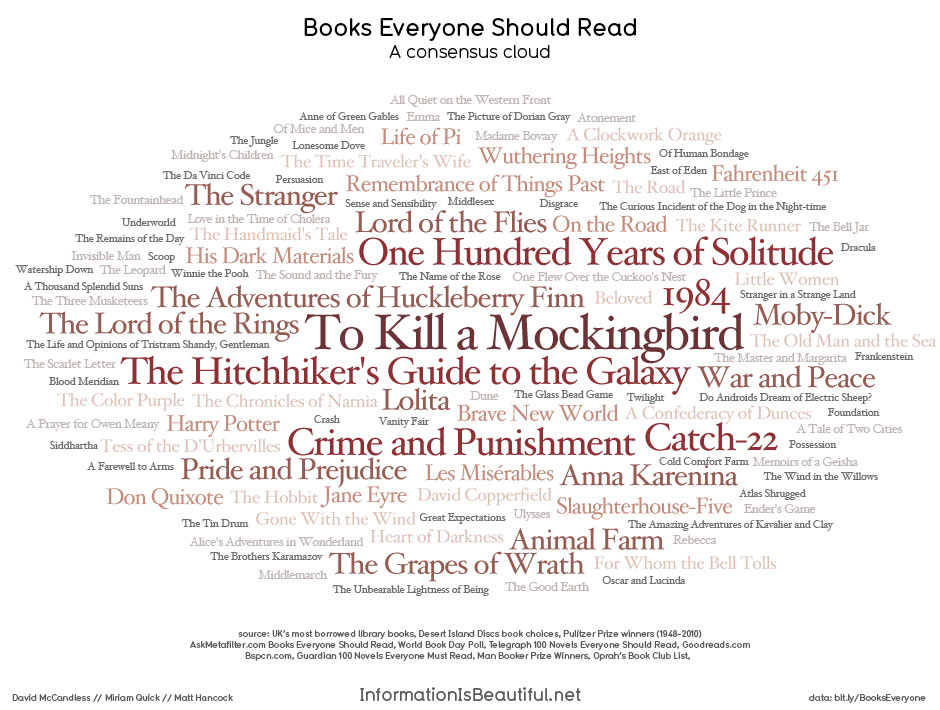
Books everyone must read

Books everyone must read is a list compiled by The Guardian after putting together the results of some surveys on reading habits. Here they explain the way they came up with the final list.


The wordcloud makes for a nice speaking session about our reading tastes and habits.

Self-study activity:
Get together with an English-speaking friend or relative and go over the titles in The Guardian list. How many books have you read? Which is your favourite? Which one have you always wanted to read but haven't got round to it?

Then, discuss the questions below about your reading habits.

Which is the last book you have read?
Do you always read in Spanish or do you also read in other languages?
Which book stands out in your memory?
Do you read the classics? / Have you ever read the classics?
Where do you usually read at home?
Which book(s) do you have on your bedside table?
Do you ever read non-fiction books?
When did you last read poetry?
Do you underline books? How?
Do you write quotations from books?
Do you read aloud, in silence, with background music?
Have you ever re-read any books?
How do you order the books you keep at home? Which criterion do you keep to?
How many books do you have at home?
What do you do to get rid of books?
How much do you spend on books every month?
Do you buy electronic books?
Do you lend / borrow books?
Do you like giving books as a present?
Are you a member of a library or book club?
How often do you go to the school library?

H/T to Larry Ferlazzo.